TL;DR
Across 7 targeted B2B cold email campaigns over 90 days, we sent 173,168 emails for a US-based boutique investment firm and generated:
- 2,080 total replies
- 265 positive responses (qualified decision-makers asking to talk)
- One campaign hit a 24.88% positive reply rate
- Another hit 20.59%
In financial services. Where inboxes are guarded and attention is expensive.
The setup
The client is a US-based boutique investment firm. Under NDA, so we can't share the name. Their goal: book qualified meetings with three different stakeholder segments. Investors, platform signups, and issuers.
The standard playbook of "blast 50,000 generic emails and hope" doesn't work in financial services. Decision-makers in this space see thousands of pitches a year. Their inbox filters are aggressive. Their attention threshold is high. A bad email isn't ignored. It gets blacklisted.
Our approach: segment-specific messaging across 7 controlled campaigns, with infrastructure that protects deliverability and a tight feedback loop on what landed.
The strategy: segment-driven messaging
Most cold email campaigns fail because they treat the audience as one group. We split this client's prospect universe into three segments and ran different angles for each.
Investors. People with capital who could deploy into the firm's offerings. The angle: get on a webinar that gives them visibility into the firm's deal flow.
Platform signups. Users who had previously interacted with the firm's platform but hadn't converted to active relationships. The angle: re-engagement around new platform features.
Issuers. Companies looking for capital or distribution. The angle: direct conversation about deal mechanics.
Different audience. Different ask. Different message. Same underlying infrastructure.
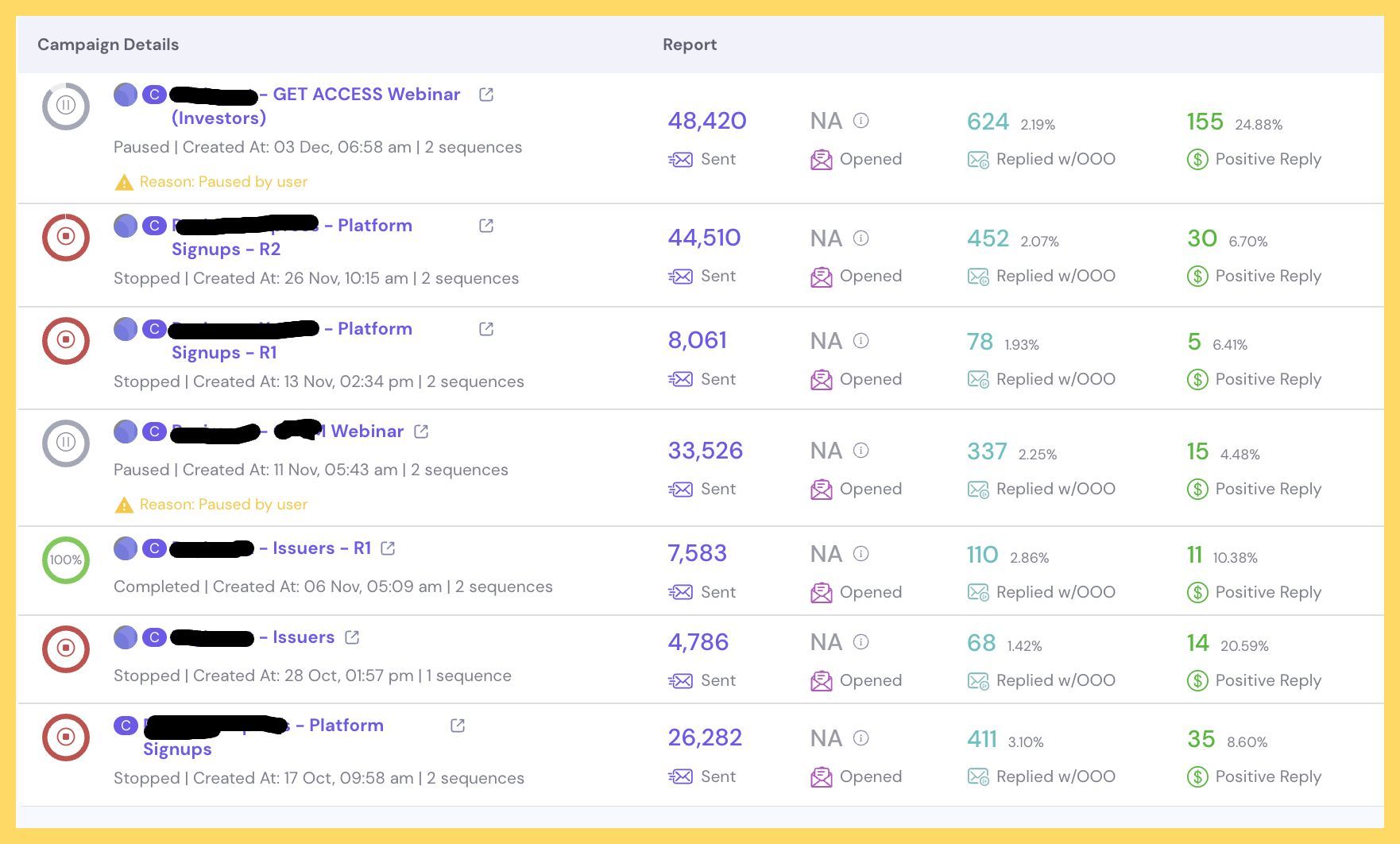
The data: 7 campaigns, 90 days
| Campaign | Sent | Replies | Reply Rate | Positive | Positive % |
|---|---|---|---|---|---|
| GET ACCESS Webinar (Investors) | 48,420 | 624 | 1.29% | 155 | 24.88% |
| Platform Signups - R2 | 44,510 | 452 | 1.02% | 30 | 6.70% |
| Platform Signups - R1 | 8,061 | 78 | 0.97% | 5 | 6.41% |
| Webinar | 33,526 | 337 | 1.01% | 15 | 4.48% |
| Issuers - R1 | 7,583 | 110 | 1.45% | 11 | 10.38% |
| Issuers (final) | 4,786 | 68 | 1.42% | 14 | 20.59% |
| Platform Signups | 26,282 | 411 | 1.56% | 35 | 8.60% |
| Total | 173,168 | 2,080 | 1.20% | 265 | 12.74% |
The headline number: 265 qualified decision-makers ready to talk, in 90 days, from cold email.
What the numbers actually tell us
Two things stand out from the campaign data.
The Investors webinar campaign hit 24.88% positive reply rate. That's not a typo. One in four people who replied to that campaign were qualified decision-makers asking to engage. The reason: precise audience targeting plus a specific, valuable ask (access to a webinar with concrete deal flow visibility). When the angle hits the right segment, response rates compound.
The Issuers final round hit 20.59% positive reply rate despite small volume (4,786 emails, 68 replies). The pattern: by the time we ran the final issuer campaign, we'd already iterated through one round of issuer messaging (Issuers R1 hit 10.38%) and refined the angle. The smaller, more targeted second round outperformed the broader first attempt by 2x on positive reply rate.
The lesson: in cold email, the iteration matters more than the initial volume. The first campaign teaches you what works. The second campaign hits.
Why financial services is hard. And how to make it work.
Cold email in financial services has unique challenges:
- Inboxes are guarded. Decision-makers in finance get hundreds of pitches a week. Their filters aggressively flag generic outreach.
- Brand reputation matters. Sending from a sketchy or unverified domain destroys credibility before the email is even read.
- Attention is expensive. Investors, fund managers, and issuers operate on tight calendars. They don't read long pitches.
What made this campaign work, and what makes any cold email campaign work in a guarded vertical:
- Separate sending infrastructure. Multiple sending domains, properly warmed inboxes, never sending from the client's main domain. Domain reputation stays clean even after 173,000 sends.
- Verified lead lists. Every email validated before sending. Bounce rates kept under 2%.
- Tight, segment-specific copy. No generic blasts. Each segment got a different opener, different problem framing, different ask.
- Real ICP signal in the audience filter. Not just "investors" but the specific kinds of investors most likely to respond to this firm's offering.
- Iterative refinement. Round 1 informs Round 2. Round 2 informs Round 3.
These aren't financial-services-specific tactics. These are cold email fundamentals applied properly. The vertical changes the language. The infrastructure stays the same. (For the avoidable-mistake side of the equation, see 3 cold email mistakes killing cleaning campaigns — same fundamentals, different vertical.)
Cold email still works. Most companies just do it wrong.
We've sent over 10 million cold emails for B2B companies across cleaning, financial services, recruiting, software, and adjacent industries. The pattern is consistent.
Companies who blast generic templates from their main domain wonder why nothing lands. Companies who segment audiences, run separate infrastructure, verify lists, and iterate get 24%+ positive reply rates on their best campaigns.
Same channel. Different execution.
If your sales team needs more at-bats
If you're a B2B operator doing $30K+ per month in revenue and your sales team needs more qualified meetings, book a strategy call. We'll review your current outbound and tell you what's broken. No pitch. No nonsense.
We work with commercial cleaning lead generation operators, financial services firms, recruiting agencies, and adjacent B2B verticals. One client per market.